
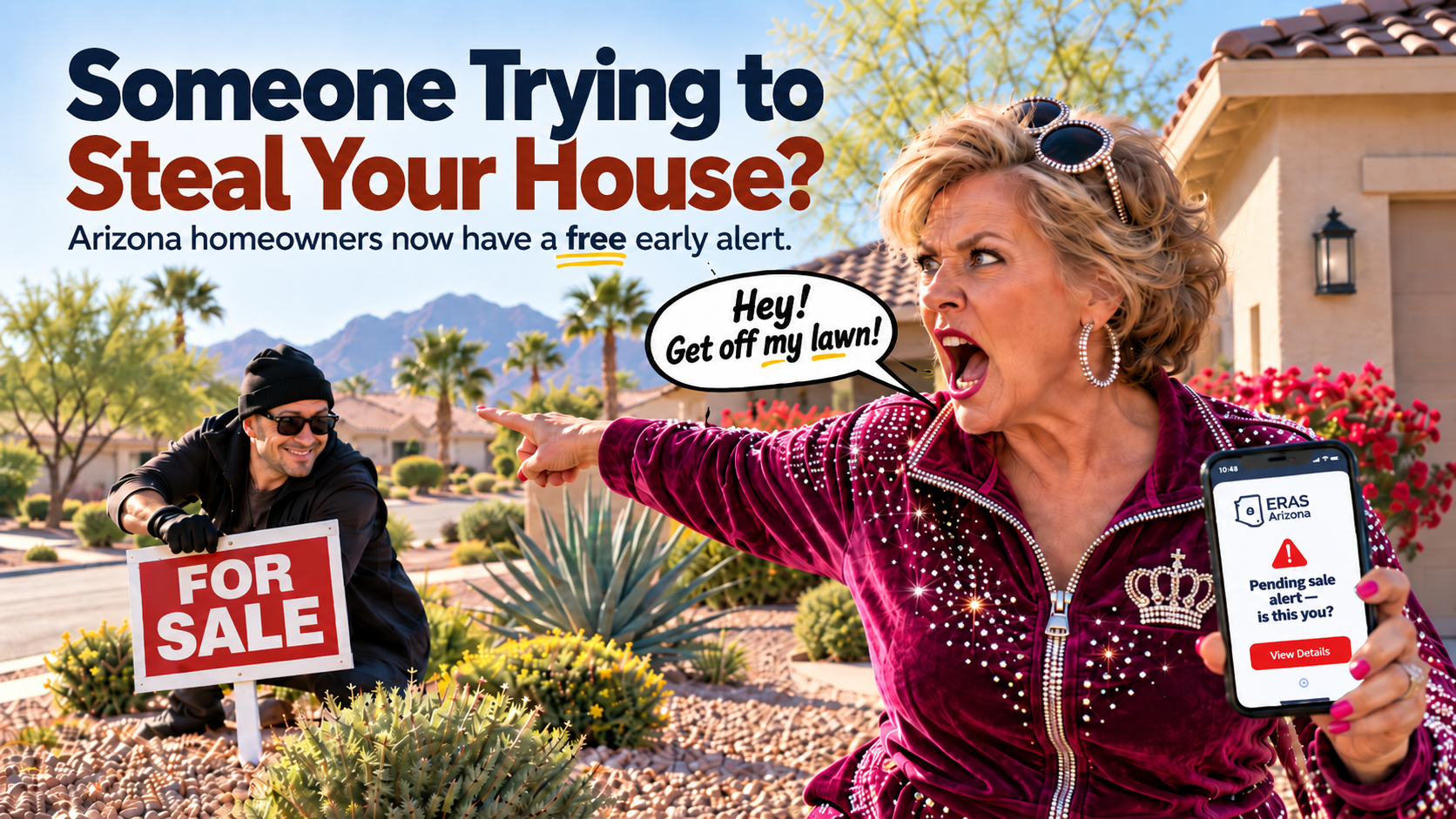
Arizona Deed Fraud: Free ERAS Alerts Can Help Protect Your Property
Register for This Free Arizona Property Alert Before Someone Tries to Sell Your Home
Have you heard those radio commercials warning that someone can steal your house by messing with the deed? I always thought they sounded a little dramatic.
Turns out, deed fraud is real. What I’m less sold on is the idea that you need to pay a company every month to protect yourself from it.
If you own property in Arizona, there’s now a free tool that may actually give you an earlier warning. The Arizona Early Real Estate Sales Alert System — ERAS — launched August 27, 2026, and it’s one of those things I’d take a couple of minutes and sign up for.
Jump to: Is deed fraud really happening? · AI & public information · Other scams to know · Three free steps · Common questions
First, this is not a sales pitch
Quite the opposite.
You’ve probably heard ads for companies like Home Title Lock. Those services generally monitor public records and notify you if something changes. They don’t actually put a lock on your deed or prevent someone from trying to file a fraudulent document. The FTC has made that distinction pretty clear.
The fraud is real. But there’s a better way to protect against it.
Arizona’s new ERAS (Early Real Estate Sales Alert System) is free, and it has one important advantage: it’s designed to alert you while a sale is still pending, rather than waiting until a new deed shows up in the public record.
If an escrow officer enters a pending sale involving a property you’ve registered, you can receive a text or email. If you’re selling, no problem. If you’re not, you’ve learned about it at a very useful time.
I’d still sign up for your county recorder’s free property alerts too. They do something different. ERAS can flag a pending sale; a recorder alert can notify you when a document has actually been recorded. Personally, I want both layers.
Is deed fraud really happening in Arizona?
Yes, and some of the cases are surprisingly brazen.
In one Scottsdale case, an elderly homeowner had moved into a care facility, leaving his paid-off house empty. People who didn’t own the property allegedly gained access, changed the locks and tried to sell it. Prospective buyers could actually tour the house.
A real estate investor became suspicious when the supposed sellers wanted about $400,000 in cash within 48 hours and parts of the paperwork didn’t look right. He tracked down the actual homeowner, who confirmed that he wasn’t selling. Police eventually arrested two women in connection with the attempted transaction.
In another Scottsdale case, someone impersonated a deceased homeowner and fraudulently transferred his property. His daughter eventually discovered what had happened, but by then the house had already moved through a real estate transaction and her father’s belongings were gone. She got the property back, but only after months of work and considerable expense.
There’s another variation that doesn’t involve impersonating the owner at all. A homeowner—often someone under financial stress—is convinced to sign documents they don’t fully understand. What they think is a loan modification, foreclosure rescue or temporary arrangement may actually transfer ownership or equity.
So this isn’t one single scam. The common thread is using someone’s property or identity to get at the equity.
AI is making this easier for scammers
AI didn’t invent deed fraud, wire fraud or identity theft. It has simply made scammers much more efficient.
A poorly written scam email used to be pretty easy to spot. Now AI can produce a perfectly normal business email, help research a property owner, create convincing fake documents and IDs, translate conversations and help someone maintain a believable identity through dozens of messages.
Voice cloning, fake images and AI-generated video are improving too. That doesn’t mean you should distrust every phone call or Zoom meeting. It means we can’t rely on “they sounded legitimate” as our main security system anymore.
And scammers have a lot of real information to work with before AI ever enters the picture. Property ownership, mailing addresses, sales history, listings and other details can often be found through public or commercially available sources.
If you’re curious about what someone could learn about your property, try the free Property Visibility Report at Home Fraud Defense:
See What’s Visible About Your Property
You can enter a residential address and see the kinds of ownership, estimated equity, occupancy, contact and listing information that could be pieced together to make an impersonation attempt sound convincing. It’s free, there’s no account or sign-up required, and the site says it does not store your search. It’s not a title search and it doesn’t tell you whether fraud is occurring—it simply shows you what information may already be visible.
That’s useful because “be careful with your personal information” is pretty vague advice. Seeing what’s already out there is much more concrete.
Vacant land deserves extra attention
If you own vacant land in Arizona, I’d make sure you register that property with ERAS too.
Vacant land is an attractive target because nobody lives there to notice anything unusual. The owner may live in another state, the parcel may have been owned for years, and there may be no mortgage. Remote transactions are also common with land, so an owner who communicates entirely by phone or email may not immediately look suspicious.
A scammer can pretend to be the owner, hire a completely legitimate real estate agent and try to sell the parcel to a completely legitimate buyer. Most of the people in the transaction can be real. The seller is the problem.
The same concern applies to vacant houses, second homes, inherited property and rentals that the owner doesn’t visit very often.
A few other scams worth knowing about
Seller impersonation is what we’ve been talking about: someone pretends to own a property and tries to sell it.
Buyer or borrower impersonation works in the other direction. Someone uses stolen or fabricated identity and financial information to pose as a legitimate buyer or borrower.
Wire fraud can happen during an otherwise completely legitimate real estate transaction. A criminal gets into the communication stream and sends fake wiring instructions. The buyer thinks the down payment is going to escrow; the money actually goes to the scammer.
My rule on wires is simple: never verify wiring instructions using the same email, text or incoming phone call that gave you those instructions. Call the escrow or title company using a number you already know is legitimate. If wiring instructions suddenly change, stop and verify everything before sending money.
Catfishing can also cross into real estate. Someone builds a relationship using a false identity, earns the person’s trust and eventually asks for money. Think worst-case-scenario online dating. That can progress to borrowing against a home, refinancing, taking out equity or selling property. AI makes the fake person easier to maintain and harder to spot.
And renters aren’t immune. Fake rental listings, copied photos, fake landlords and deposit scams are all part of the same problem. A renter can be looking at a very real property and still be talking to someone who has no right to rent it.
A free resource worth bookmarking
I’ve mentioned Home Fraud Defense because it has a collection of practical, free consumer resources rather than just telling you fraud exists. There are tools for homeowners, buyers, sellers and renters.
In addition to the Property Visibility Report, the site has tools for checking suspicious messages, learning about wire fraud, seller and buyer impersonation, unauthorized listings, rental scams and other real estate fraud.
It also has state and county resources that make it easier to find the appropriate government property-alert programs.
Find state and county property-alert resources
You don’t need an account to use the homeowner Property Visibility Report, and the site says the search isn’t stored. Renters can also use its free tools to cross-check listings and verify basic property information before sending money.
Start with these three free steps
Here are three easy ways you can start to protect against these scams.
1. See what information about your property is already visible
Run your address through the free Property Visibility Report. It gives you a sense of the information someone researching your property may already be able to find.
2. Register every Arizona property you own with ERAS
Register your primary home, rental properties, second homes and vacant land.
ERAS is the new piece of the protection puzzle because it can alert you while a sale is still pending.
3. Register for your county recorder’s free property alerts
This is separate from ERAS and worth doing too.
County-level programs can notify you when documents involving your property or name are recorded. Home Fraud Defense has a state-by-state resource directory that makes it easy to find the appropriate recorder or property-fraud alert system for your county.
Find your state and county property-alert resources
Once those three things are done, the rest is mostly good habits: independently verify wiring instructions, keep an eye on property you don’t regularly visit, help older family members set up alerts, and slow down when someone creates unnecessary urgency around money or property.
If you’re renting, here’s a checklist for you: Rental Verification Checklist. Remember: never send a deposit to someone you have not met. Check everything out first.
A Few Common Questions
Can someone really sell my house without me knowing?
They can try, and Arizona has had real cases involving owner impersonation, forged documents and fraudulent transfers. ERAS was created specifically to give property owners another opportunity to catch an unauthorized sale before it closes.
Why haven’t I heard about ERAS before?
Because it’s new. The system officially launched August 27, 2026.
Is ERAS really free?
Yes.
Is it better than a paid title-monitoring service?
For spotting a pending Arizona sale, ERAS has an important advantage: it can potentially alert you before the deed is recorded. A service that only watches recorded documents may not notify you until afterward.
ERAS doesn’t prevent every type of deed fraud, and it doesn’t replace title insurance, identity verification or normal common sense. But because it’s free and can provide an earlier warning, I’d start there before paying for monitoring.
Should I still use my county recorder’s alert?
Yes. They do different things. ERAS can alert you to a pending sale; county recorder programs can alert you when documents are recorded.
Find your county property-alert resources
Should I register vacant land, rentals and second homes?
Yes. In some ways, those properties may deserve even more attention because nobody is there every day watching what’s happening.
What if I’m a renter?
ERAS is for property owners, but renters should be paying attention to fraud too. Before sending an application fee or deposit, verify that the property really is for rent and that the person asking for the money has the right to rent it.
Home Fraud Defense has free tools and renter resources that can help with that.
Will ERAS protect me from wire fraud?
No. Wire fraud is a different problem. Always verify wiring instructions independently with your escrow or title company.
Where should I start?
Three free places:
-
Property Visibility Report
See what information about your property is visible -
Arizona Early Real Estate Sales Alert System
Register with ERAS -
County Recorder Property Alerts
Find your state and county registration resources
And for more information and tools:
Home Fraud Defense
homefrauddefense.org
Bottom line
Those radio commercials aren’t inventing deed fraud. It’s a real problem. And growing every day.
Arizona now offers a free system designed to alert property owners earlier, while a sale is still pending. Take a few minutes to see what information about your property is already visible, register each Arizona property with ERAS, and add your county recorder’s free alerts.
That’s a pretty good layer of protection for the price of free.